27 April 2026Portland Flooring
The Ultimate Guide: Hybrid vs. Laminate Flooring for Australian Homes
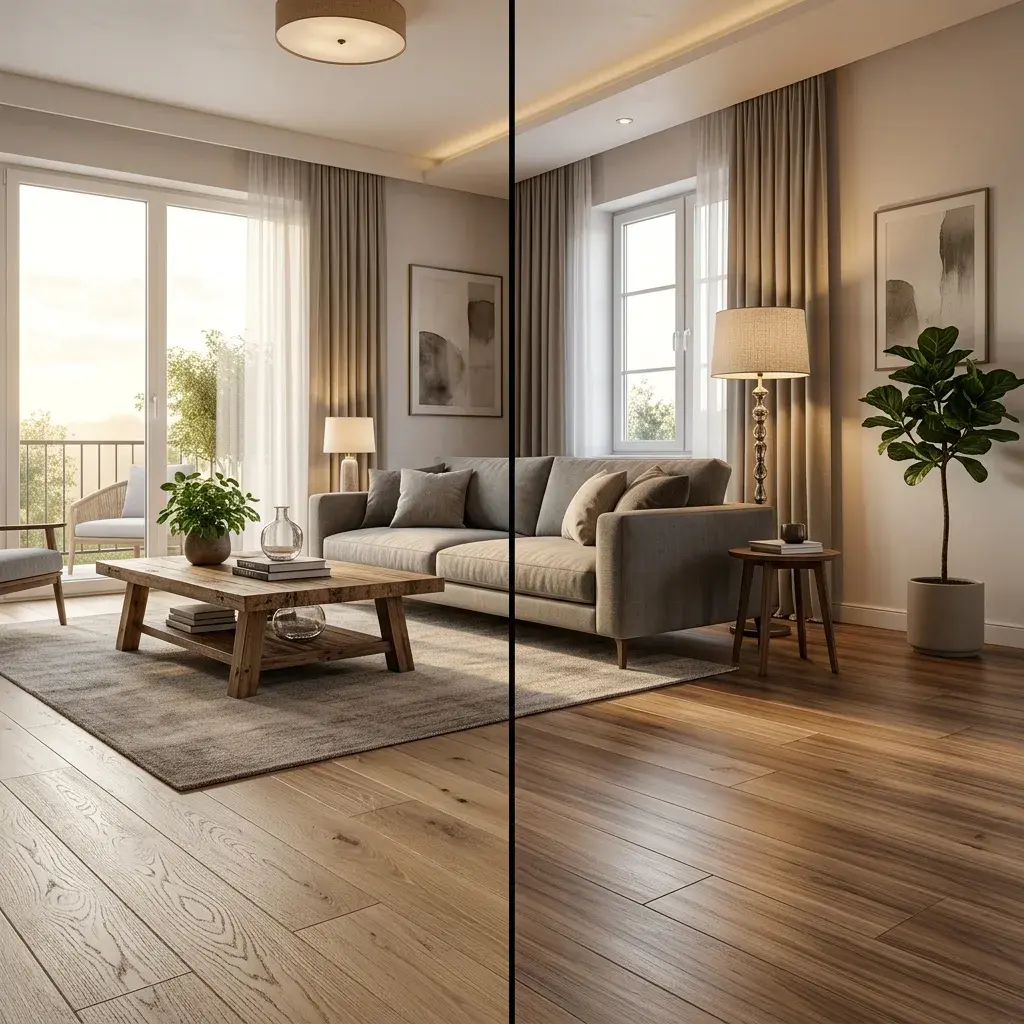
When it comes to renovating or building your dream home in Australia, choosing the right flooring is one of the most critical decisions you will make. It sets the tone for your interior design, impacts the day-to-day functionality of your space, and represents a significant investment. Among the myriad of options available today, two contenders frequently find themselves at the top of homeowners' shortlists: Hybrid Flooring and Laminate Flooring.
Both of these innovative flooring solutions offer the beautiful look of natural timber without the steep price tag or intensive maintenance required by solid hardwood. However, despite their visual similarities, hybrid and laminate flooring possess fundamentally different constructions, core materials, and performance capabilities—especially when faced with the unique challenges of the Australian climate.
In this comprehensive guide, Portland Flooring’s experts break down the "Hybrid vs. Laminate" debate. We will explore exactly what each material is, compare their durability, water resistance, aesthetic appeal, and cost, to help you make the perfect choice for your home in Victoria and beyond.
Laminate flooring has been a staple in the Australian flooring industry for decades. It revolutionized home renovations by providing an affordable, easy-to-install alternative to traditional solid hardwood.
Laminate is a multi-layered synthetic flooring product fused together through a lamination process. It typically consists of four distinct layers:
Pros:
Cons:
Hybrid flooring is the latest and most significant technological leap in the hard flooring industry. As the name suggests, it is an innovative fusion that takes the best qualities of laminate flooring and luxury vinyl plank (LVP) and combines them into one superior product.
Hybrid planks are rigid, structurally stable, and, most importantly, completely waterproof. They are generally categorized into two main types based on their core construction: SPC (Stone Plastic Composite) and WPC (Wood Plastic Composite).
A standard premium hybrid plank features:
Pros:
Cons:
To make the best decision for your home, we must compare these two flooring titans across several critical categories.
Winner: Hybrid Flooring This is the most significant difference between the two materials. Laminate flooring’s HDF core is its Achilles' heel when it comes to moisture. While some modern "water-resistant" laminates can withstand a spill for 24 to 72 hours, they are not completely waterproof. If a dishwasher leaks or a pet has an accident while you are at work, the water can seep into the joints, causing the laminate to swell irrecoverably.
Hybrid flooring, with its limestone-based SPC core, is 100% waterproof. You can completely submerge a hybrid plank in water, and it will not swell, warp, or lose its structural integrity. This makes hybrid flooring the undisputed champion for open-plan homes where you want a seamless flooring transition from the living room directly into the kitchen or laundry.
Winner: Tie (Depending on Quality) Both laminate and hybrid flooring are renowned for their durability. Laminate floors feature an aluminum oxide wear layer, which is incredibly tough and highly resistant to scratches from pets’ claws, moving furniture, and dropped objects.
Premium hybrid flooring also features a robust, commercial-grade wear layer (typically 0.5mm or higher). While laminate might have a slight edge in absolute scratch resistance against sharp objects, hybrid flooring’s rigid SPC core makes it more impact-resistant, meaning it is less likely to dent if a heavy object is dropped on it.
Winner: Hybrid Flooring (Slight Edge) In the past, laminate flooring often looked artificial, with repeating patterns and a plastic sheen. Today, high-end laminates look fantastic, featuring embossed-in-register (EIR) textures that match the physical texture to the printed grain.
However, hybrid flooring currently holds the edge in the luxury market. The manufacturing process allows for incredibly deep texturing, matte finishes, and micro-beveled edges that make it nearly indistinguishable from real timber. At Portland Flooring, our curated collections of hybrid planks—such as our European Oak and Blackbutt ranges—offer an unparalleled level of visual authenticity that elevates any space.
Winner: Hybrid Flooring Laminate flooring is known for the "click-clack" sound it makes when walked upon with hard shoes or pet claws. Because it is a hard, dense fiberboard, it reflects sound. While you can mitigate this by purchasing a separate, high-quality acoustic underlay, it adds to the overall cost.
Hybrid flooring solves this problem out of the box. The composition of the SPC core absorbs more sound than HDF, and nearly all premium hybrid floors feature a pre-attached IXPE acoustic backing. This not only significantly reduces noise transmission between floors (ideal for two-story homes and apartments) but also provides a slightly softer, more comfortable feel underfoot.
Winner: Tie Both hybrid and laminate floors utilize a floating floor installation method with a "click-lock" system. This means the planks lock together and "float" over the subfloor without the need for messy glues or nails.
Laminate is slightly easier to cut (requiring standard woodworking tools), whereas hybrid’s stone core can be tougher on saw blades. However, hybrid flooring saves time because it doesn't require the roll-out of a separate underlay.
Note: Both require a properly leveled subfloor, but hybrid flooring is slightly less forgiving of subfloor imperfections due to its rigidity.
Winner: Subjective (Based on Budget) If upfront budget is your primary constraint, laminate flooring is the winner. It is one of the most budget-friendly flooring options on the market.
However, if you evaluate Overall Value and return on investment, hybrid flooring takes the lead. While the initial material cost is higher, you do not need to purchase a separate underlay. Furthermore, its waterproof nature means you are protected against costly water damage replacements. Its durability and luxury appeal also add significant value to your home's resale price.
At Portland Flooring, we believe in sustainable building practices.
Australia is a land of extremes. From the blistering summer heat of Victoria to cold winter mornings, flooring materials are subjected to intense environmental stress.
Traditional laminate flooring, being wood-based, expands and contracts significantly with changes in humidity and temperature. This requires large expansion gaps around the perimeter of the room and expansion trims (T-moldings) in doorways, which can break up the visual flow of an open-plan house.
Hybrid flooring (SPC) is exceptionally thermally stable. The stone composite core is largely unaffected by humidity and resists expansion from heat far better than laminate or traditional vinyl. This allows for massive, seamless installations without the need for unsightly doorway transition strips, creating a sleek, continuous flow throughout your home.
The choice between hybrid and laminate flooring ultimately comes down to your lifestyle, the specific rooms you are renovating, and your budget.
Choose Laminate Flooring if:
Choose Hybrid Flooring if:
For the vast majority of modern Australian homeowners, Hybrid Flooring represents the ultimate, uncompromising solution, offering luxury, durability, and complete waterproof protection.
Located in the heart of Pakenham, Victoria, Portland Flooring has spent over 15 years perfecting the art of flooring. We don't just sell planks; we curate premium, high-end hybrid collections designed specifically for the Australian lifestyle.
From our timeless European Oak to the rich, native hues of Spotted Gum and Blackbutt, our hybrid flooring collections are built to define your space.
Ready to transform your home? Experience the quality firsthand. Request your free curated sample box today, or visit our Pakenham showroom to speak directly with our design consultants. Let's build a foundation that lasts a lifetime.
Portland Flooring - Elevating Spaces With Timeless Craftsmanship.