
27 April 2026Portland Flooring
DIY vs. Pro: How to Prepare Your Concrete Subfloor for Hybrid Flooring
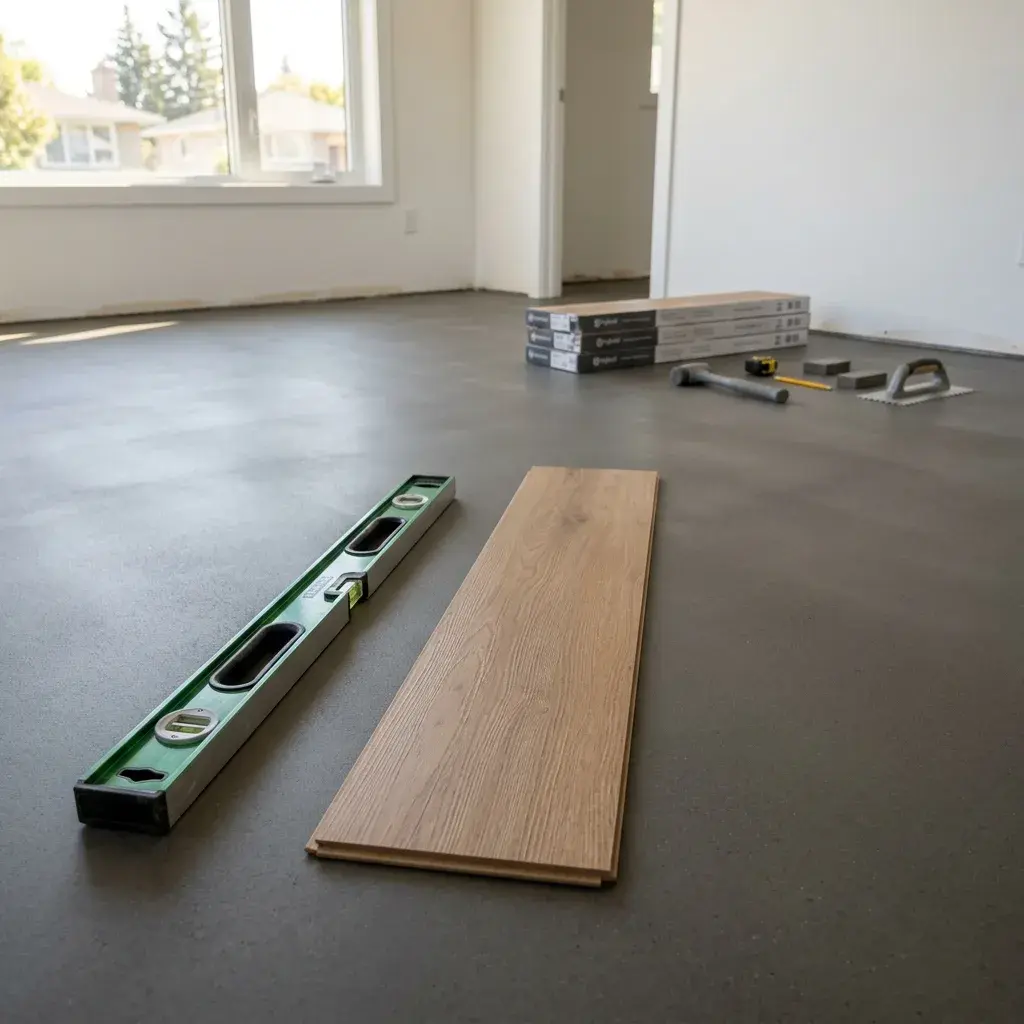

The beauty of a finished floor is entirely dependent on what lies beneath it.
One of the most common—and catastrophic—mistakes made during home renovations in Victoria is ignoring the condition of the subfloor. Homeowners often assume that because a concrete slab looks flat, it is ready for new flooring. Unfortunately, this is rarely the case.
Modern hard flooring, particularly rigid SPC Hybrid Flooring, requires an incredibly flat and stable surface. If you install premium planks over a wavy, uneven concrete slab, the floor will eventually bounce, creak, and the locking joints will crack under pressure.
In this technical guide from Portland Flooring, we explain exactly why subfloor preparation is the most critical step of any installation, how to check your concrete slab, and whether leveling is a DIY job or best left to the professionals.
First, we must clarify a crucial industry distinction: your floor does not necessarily need to be perfectly level (parallel to the horizon), but it absolutely must be perfectly flat (smooth, with no dips or humps).
If a house is built on a slight, consistent slope, hybrid flooring can be installed perfectly. However, if there are localized hills and valleys across the concrete slab, the floor will fail.
The Tolerance Standard: Most hybrid flooring manufacturers dictate that the subfloor must be flat to within 3mm over a 2-meter radius. Anything outside of this tolerance must be repaired before installation begins.
Before purchasing flooring, you must evaluate your slab.
If you lay a rigid hybrid plank over a 5mm dip in the concrete, what happens?
When you walk over that specific area, your body weight forces the rigid plank to bend down into the dip. This flexing puts immense strain on the delicate "click-lock" mechanism that holds the planks together. Over a few months of continuous flexing, the plastic lock will snap. The planks will separate, creating visible gaps that trap dirt and destroy the waterproof integrity of the floor. This completely voids the manufacturer's warranty.
If your slab has localized humps or ridges (often found where two concrete pours meet), they must be removed.
If your slab has dips, craters, or a rough texture, it must be filled.
Can you prepare a concrete subfloor yourself?
Flooring installers possess the heavy machinery, industrial vacuums, and the trained eye required to make a slab perfectly flat. The cost of paying a professional to level your floor is microscopic compared to the cost of replacing a brand-new hybrid floor that has cracked due to a bad DIY prep job.
The secret to a flawless, silent, and long-lasting hybrid floor is an invisible one: a perfectly prepared subfloor.
When you budget for a new floor in Victoria, you must factor in the cost of subfloor leveling. Do not let anyone tell you that "the underlay will absorb the bumps"—it will not.
At Portland Flooring, we emphasize perfection from the ground up. If you are unsure about the condition of your concrete slab, contact our team in Pakenham. We provide expert advice and professional installation services to ensure your beautiful new floors last a lifetime.